Saturday, January 16, 2021

Oil Temperature

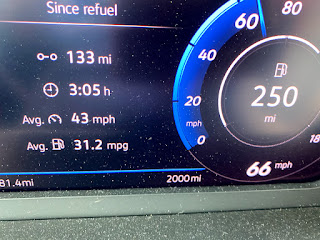
I've settle in on my new favorite dash display in the GLI.  I had be going with a trip computer summary in between the gauges, like so:


However, the GLI gives a nice trip summary after shutting the engine:


So, that had me thinking, what do I really want to know?  Well, ultimately, I want to know how soon I can really get on it and rev it out.  There's the typical coolant bar on the left side of the display, but that doesn't tell the full story.  What I really want to know is oil temperature.  Fortunately, that's configurable:


Ah, much better!  When starting off, the display shows three dashes when the temperature is too low.  It starts showing values around 123 degrees, with operating temperatures ranging between 190 and 205.

I like having the oil temperature as the default, though I can imagine switching displays on a longer trip.

Thanks, Volkswagen, for enabling driver choice, and for including oil temperature as an option.

As the odometer spins

There is something deeply satisfying about putting a lot of miles on a vehicle.  There is just no substitute for the depth of relationship that comes with putting on miles.

The high mileage champion in the garage is currently our 2008 Honda Odyssey.


We got it as we were transitioning from two to three children.  As an aside, if you have more than two children and don't tow regularly, just get a minivan.  They are just wonderful vehicles.

It’s been a workhorse for us over the ensuing years, taking us to Minnesota, Iowa, Missouri, Illinois, Indiana, Michigan, Ohio, West Virginia, Pennsylvania, Washington, D.C., Virginia, Maryland, Delaware, New Jersey, New York, Connecticut, Rhode Island, Massachusetts, Vermont, New Hampshire, Maine, Ontario, Quebec, New Brunswick, and Prince Edward Island (twice!).


Its trundled around town, grinding out urban miles, ferrying children to school and activities, and when equipped with winter tires, plowed confidently through many a Midwest winter.  


Its kept us all warm, even when it got quite cold outside:


It’s spent hours north of 80, criss-crossing the eastern half of the United States.


Without doubt, my favorite thing about it is its innate ability to haul things.  When preparing for a road trip, when someone asks if they can bring something, the answer is invariably yes.  We’ve driven I-90 across New York with the kids practicing piano on an electric keyboard in the back seat.  Need to bring a tuba to Rhode Island?  No problem, stuff it in the back.  The under-floor storage is profoundly useful for items that don’t need to be accessed during a trip, to the point that I’m a bit sad that Honda moved the spare tire to that location in our 2019 Odyssey.

Of course, the roof rails are nice for tying on Christmas trees:


On the inside, it swallowed one of my all-time favorite school projects, a life-sized sand tiger shark:


It’s about as entertaining to drive as a refrigerator.  It is big, has lots of body roll, is softly sprung, and has tall sidewalls (235/65-16).  All of this makes sense to me - it’s built for comfort and cargo, not speed.  The 240 horsepower from the V6 provides sufficient power.  Climbing through some of the mountainous terrain in New Hampshire or some of the long grades on I-80 and I-76 through Pennsylvania, I’ve never had it lose speed on a hill, even loaded up with 6 people, a dog, and cargo.  


I love the fact it has a big fuel tank, as we can knock out 450 miles before stopping for gas.

At toll booths, I frequently move quickly through the range of throttle travel, and the engine winds out to 6,000 rpm before proceeding to the next gear.  I actually enjoy the sound of the V6 as it crescendos through 4,000 rpm on the way to the redline.  Again, it’s not fast by any stretch, but it has sufficient power for its mission.  If you want a fast van, the 280 hp in our 2019 Odyssey can certainly surprise folks...

It has hauled all kinds of things, from couches to tubas, with ease.  Just fold the back seats down and pull the middle row out if needed.  Here it is, swallowing a couch:


So spacious is the cargo area that even with a couch in the back, I could close the tailgate:


I’ve put over 1,000 pounds of brick and stone in the back:


although the suspension was majorly compressed, the van didn’t complain.


It did look kind of cool when it as all loaded:


It even does a reasonable impression of a camper.  With the second row removed, the rear seats folded down, and a thick sleeping pad, it makes for a comfortable, spacious place to spend the night.  Though likely not by design, the third row cup holders and storage bins make for great nightstands. 

The odometer in the van isn’t always visible.  Toggling through the settings, you have the option to display the odometer and trip meter A, the external air temperature and trip meter A or trip meter B, and the oil life remaining.  I found that early on, I would set the display to I could see the external temperature.  Nowadays, I leave it set to the odometer.  It’s reading north of 176,000 miles as this is written.  While certainly not a world record, I find that glancing down gives me lots of joy and makes me smile.  I look down, and am reminded of my wife driving her first new car off of the dealer lot.  The time we departed South Bend when we only had three kids, and made our first stop in New York, not because people needed to use the bathroom, but because our gas light was burning brightly.  I remember the trip to D.C. where we were going to tell the kids about the impending arrival of their little brother.  Crossing Confederation Bridge for the first time as we made our way to Prince Edward Island.



The countless trips to Rhode Island.  


Climbing the one of the longer grades on I-80 in eastern Ohio in late December, the driver’s window cold against the frigid temperatures.  Using it as a mini-camper during a bitterly cold, rainy day at the soccer field.  Singing at top volume with the entire family on many a road trip.  Teaching my kids how to parallel park.  Hauling equipment to various Boy Scouts camp outs.  Filling the van with kids to go see a movie.  Countless trips to the dunes, where the van would gain five to ten pounds of sand with every visit.

Of course, as will all long-standing relationships, it’s not all roses and rainbows.  The starter died in Rhode Island when I was home, stranding my wife, kids, and in-laws at the beach.  I was jogging and had to order two separate Ubers to get everyone home safely.  Technology is pretty amazing.  Then, a week later, my wife had the van packed, loaded with snacks, and ready for the journey back to Indiana when the replacement starter failed!  There is a word deeper than disappointment to describe how my wife felt at the time.  On a different year, I was home and the rest of the family was coming back from Rhode Island when the alternator started failing in eastern Pennsylvania.  Fortunately, my wife was able to get the kids and her mother settled into a hotel, then limp it to a dealership in a neighboring town.  They were able to get a new alternator in place and get them back on the road the next morning.  Relatively early on, my wife was reversing out of a parking spot as the same time an old, rusty pickup was doing the same thing.  Contact!  The result was a scraped up bumper and cracked tail lens.  While I was able to replace the lens, the tailgate struts gave up the ghost and were replaced under warranty.

Most vividly, I remember the time I thought it was going to fail for the final time.  Just over 166,000 miles  on the clock, on a trip to see the state marching band finals in Indianapolis, it gave a death shudder and lit up the oil-related warning lights on the dash.  We hobbled into a gas station, where it proceeded to consume three quarts of oil before the dipstick registered a drop.  I thought it was over, but a new front spool valve from the wonderful folks at Valley Honda gave it new life.

Relatively recently, it gave me the opportunity to try my hand at rust repair.  Armed with a Dremel, bondo, Rustoleum, and factory paint, I repaired a bit of rust on the tail gate and the rust bubble on the driver’s rear quarter panel, just below the fuel filler door.  I think the latter is due to a design flaw.  A simple drain hole would allow accumulated moisture to vacate the area.  Either way, I determined that my bodywork skills are far from perfect, but they are good enough that the van looks passable from 20 feet away.  When something is old, well, that’s when you take care of it lest the problems get worse.

These days, it is primarily a cargo beast.  The rear seats are mostly folded down, making it easy to haul cargo.  It continues to be our beach van, driving up to the dunes with minimal worry about how much sand it will accumulate on the visit.  It makes the occasional trip to horse shows, my oldest drives it to work, and I’m teaching my oldest daughter how to drive an automatic.  When I drive it, I look down at the odometer and smile at the positive memories that keep flooding back.

The 911 elicits similar feelings of joy.  Driving around, I remember trips to the east coast, the joys of the Kettle Moraine in Wisconsin, track days, and time/speed/distance rallyes.  I remember how nervous I was the first time I drove it back to my apartment in Chicago on delivery day.  In the more than two decades of ownership, I’ve developed such a natural relationship with the car.  I know it intimately, the way it shifts, the way it brakes, the way it accelerates, the way it handles.  When there is an average speed to be maintained in a TSD rallye, I can nail that speed in the old car.  I remember driving a 996 in a TSD, and it was so much faster, responded so differently, that I had a difficult time adjusting and maintaining the correct average speed.  While I’m no longer nervous when I am in it, the joy and familiarity of operating it makes me happy every single time.

This was taken after a bath more than 15 years ago:


Just like the van, a long-term relationship requires work, care, and feeding.  After a couple of decades, the original headlights looked awful:


I ordered replacement lenses, which positively sparkle in comparison:


I took it out, and wasn't surprised that the recessed mounting area in the fender was filthy:


So, of course, I cleaned it up and waxed it:


Then, I popped in the new lens:


Ah, much better - looking bright-eyed and ready for action:


My brother took this in the fall:


It still turns my head, still makes me leave the door open when I start it, still makes me smile when I think of stuffing my entire family in the car to roll 100,000 miles:


So many good memories.  Driving it to D.C., carving through the byroads of West Virginia.  Sleeping in it on the way back from Milwaukee, when I was simply too tired to go on.  Stuffing two of my kids in it to go to Physics Day at 6 Flags.  Putting three of the kids in there and rolling through various school drop-off lines, amidst a sea of SUVs.  Break out drives in the winter.  Getting caught in the snow and having an traction control clinic, reveling in the feedback coming through the steering wheel.  It getting caught in a surprise snow in my driveway:


I really enjoy all aspects of long-standing relationships, the good and the bad.  Be it an Odyssey or a 911, I'm still crazy, after all these years.


Sunday, December 27, 2020

Transformative Traction

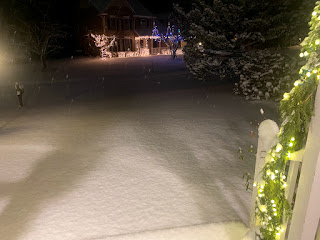
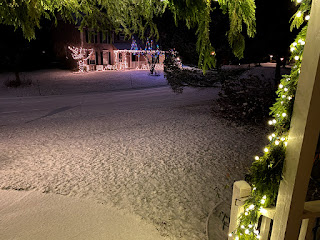
 What an absolute treat Christmas Day was in 2020!  After final preparations, we trundled off to bed with snow coming down:


By morning, the hemlocks were flocked:


And the Adirondacks were buried:


It was my favorite snow to shovel - powdery, light, and plentiful.  The dog was delighted as she tore through the snow, running wild and free:


We went for a wonderful family walk, and had a generally blissful day savoring each other's company.

Or course, I was delighted for other reasons - trying out winter tires!  This is what the streets looked like:


In the afternoon, it was time to put the Blizzaks to the test.  I went out in search of large, unplowed parking lots.  Upon finding them, I took tremendous delight in carving paths through fresh, unplowed snow:


It was peaceful and wonderful, quietly slicing through the snow.


While the snow was almost as high as the chin spoiler on the GLI, the Blizzaks cut through the snow with no problems.  Once again, the front end grip, particularly when cornering, was impressive.  

The snow was deep enough that the belly of the VW was dragging, and I had no problems powering through the snow, accelerating briskly, panic stopping with ease, and performing skidpad exercises around lamp poles.


Of note on the skidpad test is how well the traction control worked with the winter tires.  Despite my efforts to invoke lift-throttle oversteer, the traction control kept the back end planted and the Blizzaks provided all the traction I could ask for.

I think this video does a nice job showing how much fun I was having, and also demonstrates how well the Blizzaks were working:


I am also happy with how the wheels themselves performed.  In deep snow, they collected snow as anticipated:


Despite getting packed with snow, once I got out to the plowed main roads, the centrifugal force cleaned out the simple design, and I didn't have to spend any time clearing snow from the wheels.

That said, my antics did knock the front collision sensors offline:


Like I mentioned in January, I think it would be comparatively easy to put a heating element on the sensor cover.  The power is already in the area for the sensor, so why not heat the covering to keep it clear?  I hope I get the opportunity to go for a long drive in a snow/ice storm to see how long it would take to accumulate enough snow or ice up front to knock the sensors offline.

Having the Blizzaks for less than a week has provided ample opportunity to test them out, and I have to say, they are most impressive so far.

The Gift of Grip

After a green December, Christmas Eve concluded with gentle flakes falling down, finally laying down a thin duvet of fresh, fluffy white snow.  The snow wasn't deep, perhaps a quarter inch of accumulation in the street:


I was super-excited, as this would give me the first opportunity to try out the Blizzaks in fresh snow.  Backing slowly out of Mom's driveway, I slipped the GLI into first gear and drove away.  The grip was surprisingly good.  I had to be quite deliberate with the throttle to evoke wheelspin and the flickering traction light of traction control.

Driving out of the neighborhood, I steered into a 75 degree right.  The GLI turned in precisely, with no slop or sliding.  So far, so good, the grip continued to impress.  I got into the torque in both second and third gears, and the tires did a really good job of biting into the snow and imparting a feeling of confidence.

I decided to take the long way home.

The exit to the neighborhood is a on a slight incline.  While I was prepared for a clutch-slipping second gear start, I was able to start off in first gear with minimal wheelspin.  Again, it felt somewhat like driving normally.

Winding through my neighborhood, I did the cul-de-skidpad test and the hill start test:

Full stop, able to get under way without drama:


Plenty of traction on turn-in, and I was able to drive up our steep driveway without any issues at all.  The tire tracks tell the story:

"All Season" tires

Blizzak WS90s


There is just so much more grip, it's not even close.  The difference is most noticeable when turning and stopping.  Bottom line, if you live where it snows, it's hard to argue with the improved safety of a pure winter tire.

Equipped with the appropriate tire, the GLI is poised to carry on in the Passat's footsteps:

GLI


Passat


Of course, when the stock tires on the GLI wear out, this opens the door to a more interesting summer-biased tire...heh heh heh.

Friday, December 18, 2020

Initial Blizzak Impressions

 So, I decided to put winter tires on the GLI.  Any time I do winter tires, I always get a set of rims to go with them.  To me, the initial cost of another set of rims is worth it, if for no other reason than it makes swapping winter and all season tires simple.  All it takes is a socket, breaker bar, torque wrench, jack, jack stands, and about 45 minutes.

Offset?

After getting the Blizzaks mounted up, I walked around the car at home, looking at it a bit more closely.  That's when I noticed what looks like a minor offset issue.  Check out the following two pictures:


The first picture was taken in the summer, after I spent time applying a ceramic coating to the paint.  The second picture was taken with the winter wheel and tire package on the car.  As you can see, the tire sticks out from the body more than stock.

Here's another shot with the stock tires mounted:

Again, with the stock wheels, the tires don't protrude.  Here are some close-ups of what I'm talking about:
Front viewed from the front

Front tire viewed from the rear

Rear tire viewed from the rear


I think with the tires jutting out, the side of the car will get splashed much more than happens with the stock wheel.  This shot pretty much confirms that:

Note the spray on the car door.  I really wish Volkswagen would make splash guards for the GLI.  They are available on the standard Jetta, but curiously, not on the GLI.

Either way, I'm glad I treated the car with a ceramic coating, and I'm looking forward to seeing how that holds up over the winter season.

Unsprung Mass

I put about 50 miles on the car to day, running around town doing errands.  The temperature was in the mid-30s, and I was curious to see how much grip the tires had.  Gradually, I worked up to full-throttle pulls in second gear.  To my surprise, the tires didn't spin.  Instead, they just gripped and the car shot forward.  I was thrilled!

Driving a bit more, I got the impression that the GLI felt faster than usual.  At first I thought I was imagining things.  The more I drove, and the deeper into the throttle I got, the more convinced I became - the car felt noticeably quicker.  That got me thinking about unsprung mass.

Remember, when I selected a new set of wheels, I prioritized wheel weight, simplicity, and ease of cleanliness.  I knew I picked light wheels.  What I didn't know is how they compared to the stock wheels.

I looked up the weights this evening.  The stock wheels weight 28 pounds, while the winter wheels weigh a mere 19.6 pounds.  That's almost 10 pounds of unsprung weight per corner!  No wonder the GLI felt light on its feet.